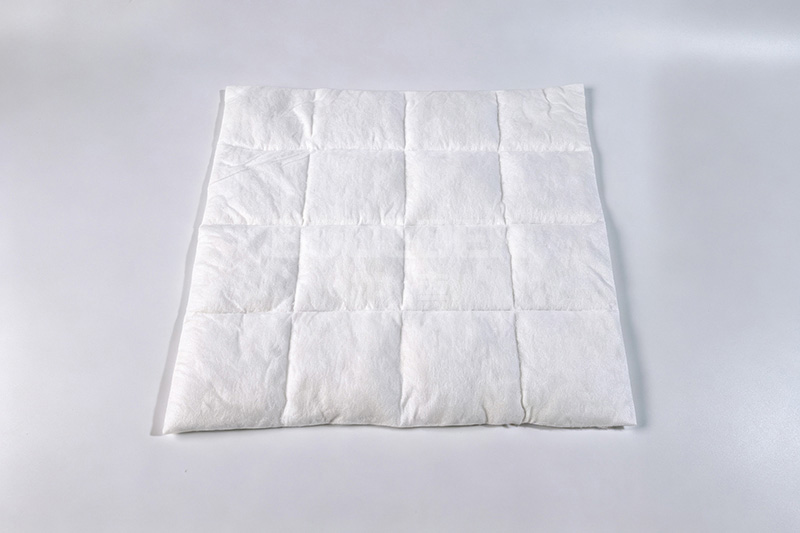
With an additional permanent magnet, why is the Meltblown Fabric more efficient and has lower resistance?
Polarized Meltblown Fabric is made from polypropylene (PP) as the raw material. After the melt-blown process, it forms an ultra-fine fiber net, and then through polarization treatment, the fibers acquire relatively stable static charges. Compared to ordinary melt-blown fabric, it enhances the electrostatic adsorption capacity by adding electrostatic properties. It is often used as the core filter layer in scenarios such as masks, air purification, and industrial dust prevention. Ordinary melt-blown fabric mainly relies on the micropores formed by the interweaving of fibers for physical interception; while polarized melt-blown fabric uses charged fibers to generate an electric field to capture charged particles and polarize some neutral particles for capture, thereby improving the filtration performance of tiny particles without significantly increasing breathing resistance.
Polarization treatment can be understood as "injecting and locking charges into the melt-blown fabric". Common methods include corona discharge, water polarization, and adding polarizing masterbatch to the PP raw material to assist in charge storage. Corona polarization uses a high-voltage electric field to ionize the air and deposit the charges on the surface and shallow layers of the fibers, making the process mature and suitable for batch production; water polarization uses high-pressure pure water jets to rub the fibers and generate static electricity, with a deeper charge distribution and better stability in humid and warm environments; the polarizing masterbatch forms "charge traps" by adding minerals like feldspar to the PP, helping to retain the static charges for a longer time. It is important to note that the polarization effect is affected by storage temperature, humidity, and usage duration, and when selecting materials, one should also consider filtration efficiency, ventilation resistance, and charge retention ability.
Unpolarized ordinary Meltblown Fabric only relies on the ultra-fine fiber micropores for mechanical interception, resulting in limited filtration capacity. The core difference of polarized melt-blown fabric lies in the "mechanical interception + electrostatic adsorption" dual mechanism: Mechanical interception relies on the three-dimensional chaotic ultra-fine fiber network, which captures dust and large particle aerosols through inertial collision, interception, and Brownian diffusion; Electrostatic adsorption relies on the stable charges carried by the fibers, causing charged particles to be adsorbed under the action of the electric field force, and neutral tiny particles to be polarized and captured, which is helpful for capturing sub-micron particles smaller than the filter material's pore size, achieving efficient and low-resistance filtration.
Currently, the common routes in the industry are corona polarization and water polarization. Corona polarization is more mature, relying on high-voltage corona discharge to deposit charges in the melt-blown fibers, combined with polarizing masterbatch to enhance charge retention ability, with stable production efficiency and large market usage; Water polarization uses high-pressure water jets to rub the fibers and generate static electricity, with deeper charge distribution and slower attenuation, better stability in humid environments, and is mostly used in scenarios requiring higher protection filter materials. The base material is mostly polypropylene, with fine fibers and high porosity, commonly covering 15-50 g/㎡. It can be adjusted as needed. Performance indicators usually focus on particle filtration efficiency, bacterial filtration efficiency, and airflow resistance (under corresponding test standards conditions), and charge stability is also a key factor for long-term use; High temperature and high humidity accelerate charge attenuation, and it is recommended to avoid humid and hot environments during storage and processing to ensure stable filtration performance.
Boulder was founded in 2007, with its headquarters located in Los Angeles, USA. It is an international enterprise specializing in the research and development, production and solution services of high end nonwoven fabric materials. Its products cover medical nonwovens, hygiene nonwovens, filter media nonwovens, automotive nonwovens and other fields.
Currently, in China, there are Lianyungang Boulder Industrial Co.,Ltd.、Jiangsu Boulder Filtration Technology Co., Ltd.、Hubei Boulder Material Technology Co., Ltd.、Boulder(Hubei)Auto Materials Co., Ltd.The company has deeply focused on the fields of medical, hygiene care, filter materials and industrial materials, and is committed to providing global customers with high performance, high stability, high value added nonwoven fabric products and systematic solutions.